
Table of Contents
- Introduction
- What Group Tennis Lessons Actually Look Like
- How Group Lessons Differ from Private Coaching
- The Real Benefits of Learning in a Group
- Who Thrives in Group Tennis Lessons
- Who Should Consider Private Lessons Instead
- How Group Size Affects Your Experience
- Cost Comparison: Group vs Private in Singapore
- How Group Lessons Build Match Readiness
- The Hybrid Approach: Combining Both Formats
- What to Ask Before Joining a Group Class
- How SimplyTennis Structures Group Lessons
- Conclusion
Introduction
When people in Singapore start exploring tennis lessons, the choice between private and group coaching comes up almost immediately. Both formats work. Both can produce real improvement. But they develop skills in different ways and suit different kinds of learners. The question is not which format is objectively better — it is which one is right for you, at this stage of your tennis journey.
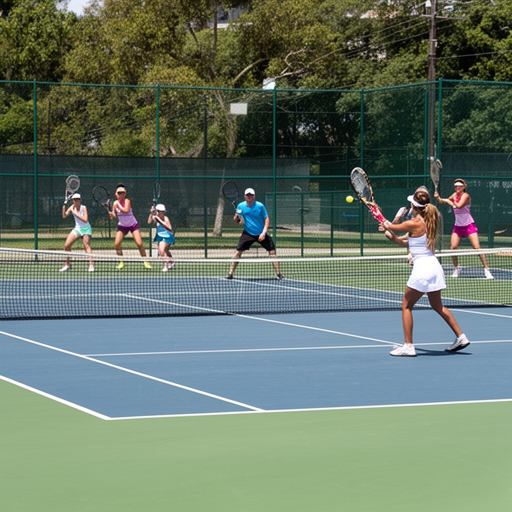
This guide focuses specifically on group tennis lessons: what they look like, what they deliver, who benefits most from them, and how to know whether enrolling in one is the right decision before you commit.
What Group Tennis Lessons Actually Look Like
A common concern among people considering group lessons is that they will spend the session watching others play while waiting for their turn. In a large class, that concern has some validity. In a well-structured small-group program, it does not.
At SimplyTennis, group lessons are kept to a maximum of three participants per coach. This size is deliberately chosen to ensure that each student receives regular feedback throughout the session rather than occasionally. The coach can observe all three players during rotational drills, correct technique in real time, and adjust the session if one player is struggling with a particular skill.
A typical group session begins with a warm-up covering movement, coordination, and basic stroke preparation. The main session follows a theme — forehand mechanics, rally consistency, serve introduction — with drills that rotate between players to maximise active hitting time. The session closes with a brief cool-down and a summary of what was worked on and what to focus on before the next lesson.
The atmosphere in group lessons is typically more relaxed than private sessions. Beginners tend to feel less self-conscious when they can see peers at a similar level also navigating early challenges. This social comfort often removes hesitation and makes it easier to try new techniques without fear of judgement.
How Group Lessons Differ from Private Coaching
The structural difference between group and private coaching is straightforward: in a private lesson, the coach’s attention is entirely on one student. Every drill, every piece of feedback, and every minute of the session serves that individual’s development alone. In a group lesson, that attention is shared.
The practical implications of this difference matter more for some players than others. For beginners who have very specific technical problems — say, a grip that will cause injury if uncorrected, or swing mechanics that are fundamentally misaligned — private coaching allows those problems to be identified and addressed immediately. The same correction in a group setting may take longer to receive because the coach is observing multiple students at once.
What group lessons offer that private lessons inherently cannot is exposure to other players. Watching someone else receive a correction can be just as instructive as receiving it yourself, particularly for visual learners. Rallying against a peer rather than feeding balls with a coach introduces unpredictability that more closely mirrors actual match conditions. And the social dynamic of group training motivates many players in ways that one-on-one sessions do not.
The Real Benefits of Learning in a Group
The benefits of group tennis lessons are often underestimated by beginners who assume that private coaching is automatically superior. In practice, the advantages of group learning are substantial and in some respects difficult to replicate in a private format.
Social motivation is one of the most significant. Many players, particularly adults who are returning to sport after years away or who feel self-conscious about learning something new in their thirties or forties, find it easier to stay committed when they have a consistent group of peers at a similar level. The accountability of showing up when others expect you is real and practical.
Competitive stimulus is another. Even a gentle competitive element — who can sustain a longer rally, who lands a shot closest to the target — raises effort levels in ways that are harder to generate when training alone with a coach. Competition in a safe and supportive group environment builds the mental resilience and composure under pressure that eventually becomes match temperament.
Adaptability is a third benefit that is unique to group training. Learning to read and respond to different playing styles, even within a small group, develops court awareness and tactical thinking that purely feed-based private drilling does not always address. A player who has only ever hit balls fed by their coach often struggles when they first play against real opponents whose timing, pace, and placement are unpredictable.
Who Thrives in Group Tennis Lessons
Group lessons suit certain types of learners particularly well.
Social players who find exercise more enjoyable in company will consistently get more from group sessions than from solo training. If you are the kind of person who joins a running group rather than running alone, the same dynamic applies to tennis.
Budget-conscious beginners who want structured coaching without the cost of private sessions will find group lessons the most accessible way to start. The per-session cost is significantly lower, which makes it possible to train more frequently for the same monthly spend.
Players who learn well by observation — watching others receive corrections and applying those observations to their own game — benefit strongly from the group format. Not every instructional moment needs to be directed at you to be useful to you.
Recreational players whose primary goal is enjoyment, fitness, and social connection rather than rapid competitive development tend to find group lessons more aligned with those goals. The atmosphere is conducive to having fun while learning, which sustains long-term participation.
Adults who are nervous about learning something new and feel less exposed in a group where everyone is at a similar level often find the group format removes the social anxiety that makes individual lessons feel uncomfortably high-stakes.
Who Should Consider Private Lessons Instead
Group lessons are not the right choice for every beginner. Several situations make private coaching the more sensible starting point.
Players with a specific technical problem that needs urgent correction — particularly grip or swing mechanics that could cause injury — benefit from the immediate and undivided attention that private lessons provide. Letting a problem persist across multiple group sessions while waiting for the coach’s rotating attention can entrench a bad habit faster than it is corrected.
Adults who are significantly more self-conscious than the average beginner may find group lessons stressful rather than socially supportive, at least initially. In this case, starting with private lessons to build basic confidence before transitioning to a group is a sensible progression.
Players with tightly constrained schedules who can only commit to one lesson per week and want every minute of that session to deliver maximum individual value will often find private coaching a better use of that limited training window.
Children who learn at a noticeably different pace from peers their age — whether faster or slower — may benefit from private lessons that can be pitched precisely at their level rather than adjusted to a group average.
How Group Size Affects Your Experience
Group size is possibly the single most important variable in determining whether a group lesson feels valuable or frustrating. A group of three with one coach is a fundamentally different experience from a group of eight with one coach. In the latter, waiting time is high, individual feedback is rare, and the session resembles a crowd exercise more than structured coaching.
SimplyTennis caps group lessons at three participants per coach. This is a deliberate choice that preserves the essential quality of personal coaching within a group format. With three players, the coach can observe each student during every drill, correct mistakes before they become habits, and maintain meaningful session structure without anyone spending significant time standing and waiting.
When evaluating any group lesson program, asking about maximum class size before enrolling is one of the most useful questions you can ask. The answer will tell you more about lesson quality than almost any other piece of information.
Cost Comparison: Group vs Private in Singapore
Group lessons are consistently more affordable than private coaching in Singapore, and the cost difference is meaningful enough to influence how often most beginners can afford to train.
Private tennis lessons in Singapore generally range from SGD 60 to SGD 130 per hour depending on the coach’s experience and the student’s level. Group lessons typically cost between SGD 20 and SGD 60 per person per session.
For a beginner who wants to train twice a week, the difference between group and private pricing can determine whether consistent twice-weekly training is financially sustainable. Two group sessions per week at SGD 40 each is SGD 320 per month. Two private sessions at SGD 100 each is SGD 800 per month. Both produce meaningful improvement, but one is accessible to a far wider range of budgets.
For those on a tight budget, SimplyTennis specifically recommends group classes as the more affordable entry point to structured tennis coaching.
How Group Lessons Build Match Readiness
One of the genuine strengths of group tennis lessons that is often overlooked is how naturally they prepare players for actual match play. Rallying against a fellow beginner, even at a basic level, introduces the variability and unpredictability that feeding drills with a coach cannot fully replicate.
In a match, you cannot predict the height, pace, spin, or placement of the ball coming toward you. You must read it, adjust your position, time your swing, and recover for the next shot. These are skills that develop most effectively when practised against live ball flight from a real opponent rather than a predictable coaching feed.
Group lessons introduce this element naturally. Even short cooperative rallies between group members during practice drills build the tracking, timing, and recovery skills that translate directly to match play. Players who combine group lessons with private coaching often develop match readiness faster than those who rely on private coaching alone.
The Hybrid Approach: Combining Both Formats
Many of the most effective development pathways for beginners in Singapore combine private and group lessons rather than choosing exclusively between them.
A common and effective structure is one private lesson per week for focused technical development, combined with one group session per week for rally practice and social training. This combination addresses the main strengths of each format: the private session provides personalised correction and structured progression, while the group session builds adaptability, competitive experience, and enjoyment.
For players whose budget constrains them to one session per week, starting with group lessons and adding occasional private sessions when specific technical issues arise is a sensible approach. The private sessions serve as focused correction windows rather than the primary training vehicle.
SimplyTennis offers both private and group programs for adults and children, making it straightforward to design a combined approach that suits individual goals, schedules, and budgets.
What to Ask Before Joining a Group Class
Before committing to a group tennis lesson program, several practical questions are worth asking.
What is the maximum class size? As noted, three participants per coach is meaningfully different from six or eight. The answer matters significantly to lesson quality.
What level are the other participants? Training with players at a broadly similar level ensures that drills are pitched appropriately and that no one is consistently left behind or held back.
Is there a structured curriculum, or are sessions decided on the day? A program with a clear progression plan produces faster improvement than ad hoc sessions.
What happens if another participant in your group cannot attend? Understanding how the session proceeds when group numbers drop to two or one is worth clarifying before booking.
What is the cancellation and rescheduling policy? At SimplyTennis, cancellations require at least twenty-four hours notice. For group lessons where an alternative class is available during the same week, makeup attendance may be arranged. The full lesson fee applies if notice is given in less than twenty-four hours.
How SimplyTennis Structures Group Lessons
SimplyTennis offers adult group lessons with a maximum of three participants per coach. Sessions are available on weekday mornings and evenings as well as weekend mornings and evenings, giving working adults and families a range of scheduling options.
Group lessons take place at students’ own condominium courts or at partner condominiums in the Orchard Road area. Tennis balls are provided by the coach. Students are encouraged to bring their own racket, and advice on racket selection is available for those who need it.
Kids group lessons are similarly capped at three children per coach, with two age brackets: four to nine years old and ten to fifteen years old. Modified equipment including softer age-appropriate balls, lower nets, and lighter rackets is used for younger children to support appropriate learning progression.
Payment for a minimum of four sessions is required in advance, with the bundle to be completed within five weeks of sign-up.
Conclusion
Group tennis lessons in Singapore are not a compromise or a second-best option. For the right player, they are the most appropriate format — offering affordable structured coaching, social motivation, competitive stimulus, and match-ready practice in a single session.
Whether group lessons are right for you depends on your learning style, budget, goals, and how you respond to social training environments. If you are a social learner on a practical budget who wants to enjoy the process of learning tennis alongside others at a similar level, group lessons are an excellent starting point. If you need immediate intensive technical correction or prefer one-on-one focus, private coaching is more suitable — at least initially.
Many players in Singapore find that a combination of both formats delivers the most complete and enjoyable development pathway. SimplyTennis offers both private and group programs for adults and children across Singapore.
To find out more or to book your first session, visit simplytennis.sg.