
Good tennis footwork is one of the most important foundations of a strong tennis game. You can have a powerful forehand, accurate serve and reliable backhand, but poor movement can make it difficult to use these skills effectively during a match.
For players looking for professional tennis lessons Singapore, footwork should be an important part of regular training. Learning how to move efficiently can help you reach the ball earlier, maintain balance and recover into position more effectively.
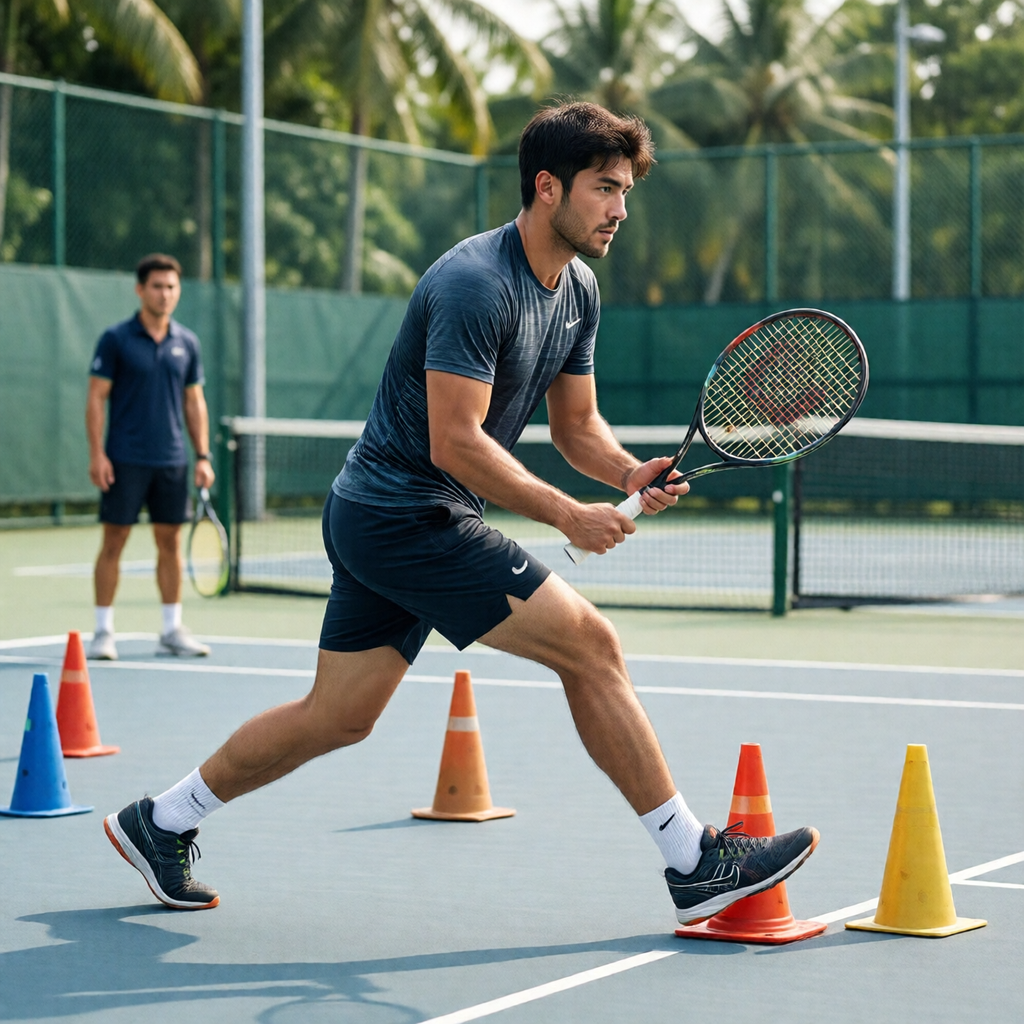
Table of Contents
- Why Tennis Footwork Matters
- Common Footwork Problems
- The Split-Step Drill
- Side-to-Side Shuffle Drill
- Forward and Backward Movement
- Cone Footwork Drill
- Recovery Footwork Drill
- Shadow Tennis Drill
- How Often Should You Practise Footwork?
- Improve Your Tennis Footwork with Professional Coaching
- Conclusion
Why Tennis Footwork Matters
Tennis requires constant movement. During a rally, you may need to move sideways to reach a wide forehand, step forward to attack a short ball or move backwards when your opponent hits a deep shot.
Good footwork allows you to get into the correct position before hitting the ball.
Some of the main benefits include:
- Better court positioning
- Faster movement towards the ball
- Improved balance
- More consistent strokes
- Faster recovery after each shot
- Better preparation for forehands and backhands
- Improved ability to change direction
- Greater confidence during rallies
A player with good technique but poor footwork may still struggle because they frequently hit the ball while off-balance or too far away from the ideal contact point.
Common Footwork Problems
Many recreational tennis players develop movement habits that limit their performance.
Standing Too Upright
Players who stand too straight often take longer to react. A slightly bent-knee ready position makes it easier to push off in any direction.
Watching the Ball Instead of Moving
Some players wait until the ball is almost beside them before moving. Good footwork starts as soon as you understand where the ball is going.
Not Recovering After a Shot
After hitting the ball, you should immediately think about your next position. Remaining in the same location can leave large areas of the court open.
Taking Inefficient Steps
Crossing your feet unnecessarily or taking too many tiny steps can slow you down.
Effective tennis movement uses a combination of larger steps, shuffle steps and small adjustment steps.
The Split-Step Drill
The split step is one of the most important movements in tennis.
It is a small hop performed just before your opponent’s shot reaches you. When you land, your feet are ready to push towards the ball.
How to practise
- Start in your tennis ready position.
- Keep your feet approximately shoulder-width apart.
- Perform a small hop.
- Land softly on the balls of your feet.
- Immediately move towards one side.
- Return to the centre.
- Repeat in the opposite direction.
The split step should be small and controlled. You do not need to jump high.
Practise the movement without a ball first. Once comfortable, ask a partner or coach to direct you towards different areas of the court.
Side-to-Side Shuffle Drill
Lateral movement is essential when dealing with balls hit towards the sides of the court.
Place two cones several metres apart. Start beside one cone and face forward.
Shuffle towards the opposite cone without crossing your feet. Once you reach the cone, immediately shuffle back.
Keep your knees bent and your body balanced throughout the drill.
Try to avoid standing up between movements. Maintaining a relatively low position makes it easier to change direction.
As your footwork improves, increase the speed while maintaining control.
Forward and Backward Movement
Tennis players need to move in more than one direction.
Place one cone near the baseline and another several metres towards the net.
Start at the baseline cone. Move forwards towards the second cone, then change direction and return.
When moving backwards, stay aware of your surroundings and maintain good balance.
This drill is especially useful for players who struggle when approaching short balls or dealing with deep shots.
You can make the exercise more realistic by adding a shadow swing each time you reach the front cone.
Cone Footwork Drill
Cone drills are excellent for practising changes of direction.
Place four cones around the court to represent different areas where you might need to move during a rally.
Start in the centre.
Move towards one cone, perform a shadow forehand or backhand, then return towards the centre.
Continue with the remaining cones.
For example:
Centre → Forehand Corner → Centre → Backhand Corner → Centre → Short Ball → Centre
This teaches your body to combine movement, preparation and recovery.
Rather than focusing purely on speed, concentrate on reaching each position under control.
Recovery Footwork Drill
Recovery is just as important as reaching the ball.
Imagine that you have hit a forehand from the right side of the court. Once the shot is completed, you need to begin moving back towards an appropriate position.
To practise:
- Start near the centre of the baseline.
- Move towards the forehand side.
- Perform a shadow forehand.
- Push off and recover towards the centre.
- Repeat on the backhand side.
You can eventually have a coach feed alternating balls to different locations.
This creates a more realistic training environment and teaches you to recover automatically after every shot.
Shadow Tennis Drill
Shadow tennis is another useful way to improve movement without requiring a ball.
Imagine that you are playing a real rally.
Start in the ready position and perform the movements you would normally use during a point.
For example:
Split step → Move → Set → Forehand → Recover → Split step → Backhand → Recover
You can also visualise different situations, such as:
- Wide forehand
- Wide backhand
- Short ball
- Deep ball
- Approach shot
- Volley
- Overhead
The advantage of shadow tennis is that you can focus entirely on movement and positioning.
How Often Should You Practise Footwork?
You do not need to spend an entire training session working exclusively on footwork.
For most recreational players, 10 to 15 minutes of focused footwork training can be incorporated into a normal tennis session.
For example:
| Drill | Suggested Time |
|---|---|
| Split step | 3–5 minutes |
| Lateral shuffle | 3–5 minutes |
| Forward/backward movement | 3–5 minutes |
| Cone drills | 5 minutes |
| Recovery drills | 5 minutes |
The most important factor is consistency.
Practising footwork regularly can help turn correct movement patterns into habits.
However, beginners should focus on technique before attempting maximum speed. Moving quickly with poor technique can reinforce inefficient movement patterns.
Improve Your Tennis Footwork with Professional Coaching
Footwork is easier to improve when you have someone who can observe your movement and provide immediate feedback.
A tennis coach can identify problems such as late reactions, poor recovery positioning, excessive steps or incorrect body positioning.
Structured tennis lessons Singapore can also combine footwork exercises with stroke development.
Instead of practising movement separately from tennis, coaches can incorporate footwork into realistic drills involving forehands, backhands, serves, volleys and point situations.
This allows players to understand not only how to move but also when to move.
Beginners can develop good movement habits from the beginning, while intermediate players can work on faster recovery, directional changes and court coverage.
Footwork for Different Skill Levels
Beginners
Beginners should concentrate on:
- Ready position
- Split step
- Basic lateral movement
- Balance
- Recovery after hitting
The objective is to develop good habits rather than speed.
Intermediate Players
Intermediate players can introduce:
- Faster direction changes
- Wider court movement
- Combination drills
- Recovery patterns
- Movement under pressure
At this stage, footwork should increasingly be connected to actual rally situations.
Advanced Recreational Players
More experienced players can work on explosive movement, reaction drills and unpredictable feeding patterns.
The goal is to reduce unnecessary movement while reaching the ball quickly and maintaining balance.
Conclusion
Strong tennis footwork can make a significant difference to your overall game. It helps you reach more balls, prepare earlier and maintain better balance when hitting your shots.
Simple drills such as split steps, lateral shuffles, cone exercises, shadow tennis and recovery drills can be incorporated into regular training.
Whether you are completely new to tennis or already playing regularly, improving your movement can help you become a more efficient and confident player.
With consistent practice and guidance from an experienced coach, better footwork can become a natural part of your game.