
Starting tennis for the first time can be exciting, but it is normal to feel unsure about what will happen during your first lesson. You may wonder what equipment you need, whether you need to know how to play already or how difficult the training will be.
The good news is that beginners do not need previous tennis experience to start learning. A well-structured lesson introduces the fundamentals gradually and gives you the opportunity to develop good habits from the beginning.
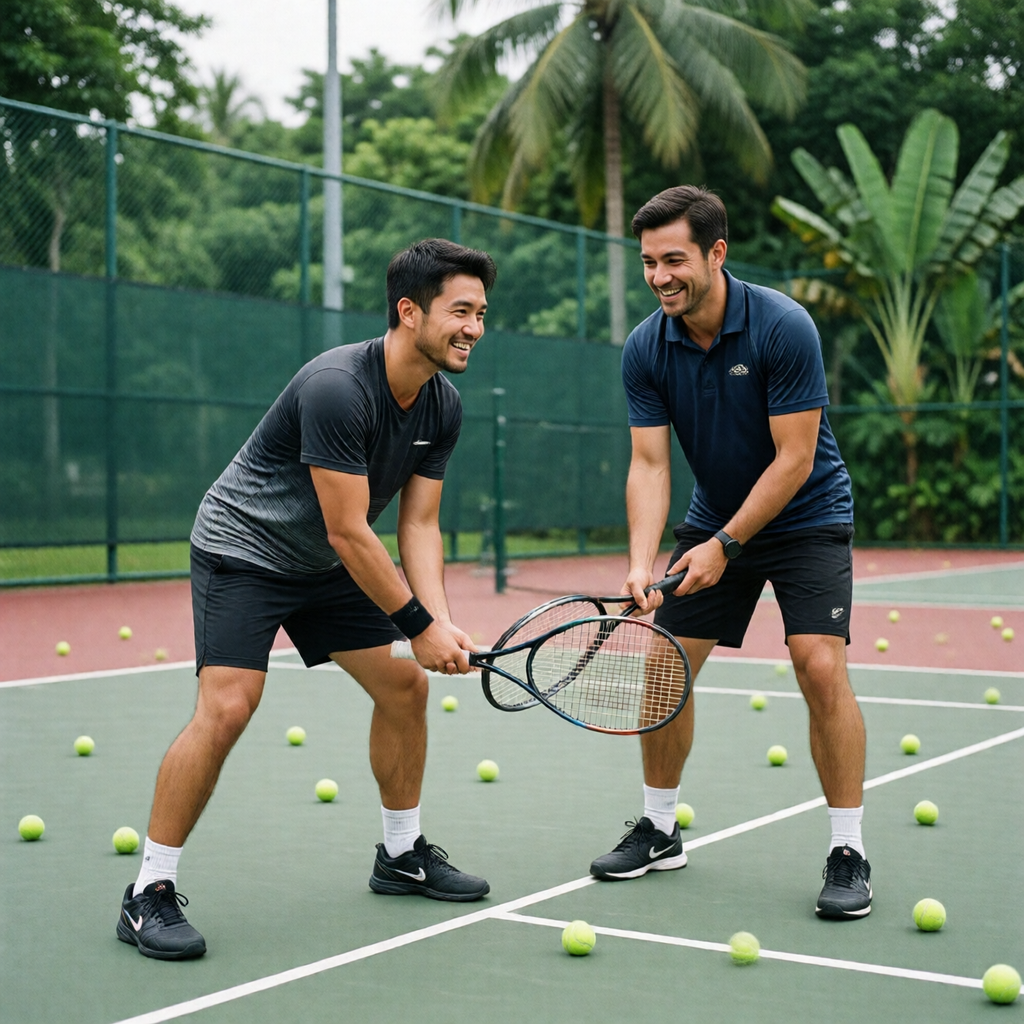
For anyone looking for tennis coaching Singapore, understanding what happens during a first lesson can make the experience more comfortable and enjoyable.
Table of Contents
- Do You Need Tennis Experience Before Your First Lesson?
- What Should You Bring?
- Starting with a Warm-Up
- Learning the Ready Position
- Understanding the Tennis Grip
- Learning Basic Footwork
- Introduction to Forehand and Backhand
- Learning How to Hit the Ball
- What About Serving?
- How a Coach Provides Feedback
- What Happens After Your First Lesson?
- How to Get the Most Out of Beginner Tennis Lessons
- Conclusion
Do You Need Tennis Experience Before Your First Lesson?
No.
One of the biggest misconceptions about tennis coaching is that you need to know how to play before attending your first lesson.
Beginner coaching is specifically designed for players who are starting from the basics.
Your coach will normally introduce fundamental skills such as:
- How to hold the racket
- How to stand correctly
- How to move around the court
- How to prepare for a shot
- How to make contact with the ball
- Basic forehand technique
- Basic backhand technique
You do not need to be able to rally before your first lesson.
In fact, learning the correct technique from the beginning can help prevent bad habits from developing.
What Should You Bring?
You do not need complicated equipment for your first tennis lesson.
A typical beginner should bring:
- Tennis racket
- Comfortable sports clothing
- Tennis shoes
- Water bottle
- Towel
- Cap or sunscreen for outdoor sessions
If you do not own a racket yet, check with your coach or tennis academy about whether equipment can be provided.
Tennis shoes are also important. Running shoes are designed mainly for forward movement, while tennis involves frequent lateral movement and sudden changes of direction.
A suitable tennis shoe can provide better support for these movements.
Starting with a Warm-Up
Your first lesson will usually begin with a warm-up.
The purpose is to prepare your body for movement and tennis-specific activity.
Your coach may ask you to perform simple exercises such as:
- Light jogging
- Side shuffles
- Dynamic leg movements
- Arm movements
- Light footwork exercises
The warm-up may also introduce basic tennis movements.
For beginners, this is a useful opportunity to become familiar with the court and understand how you should move during a rally.
Learning the Ready Position
One of the first technical concepts you may learn is the tennis ready position.
The ready position allows you to react quickly when your opponent hits the ball.
A basic ready position involves:
- Feet approximately shoulder-width apart
- Knees slightly bent
- Body relaxed
- Racket held in front
- Weight balanced on the balls of your feet
- Eyes focused towards the incoming ball
Although this looks simple, it is an important foundation.
A good ready position makes it easier to move towards either side of the court.
Understanding the Tennis Grip
Your coach may then introduce the correct racket grip.
Beginners often hold the racket too tightly or use a grip that makes it difficult to control the racket face.
Your coach may teach different grips depending on the shot.
For example, the grip used for a basic forehand may differ from the grip used for a serve.
Do not worry if the grip feels uncomfortable at first.
Holding a tennis racket correctly is a new movement for beginners, and it takes time for the position to feel natural.
The goal during the first lesson is to understand the basic concept rather than immediately achieve perfect technique.
Learning Basic Footwork
Tennis is not just about swinging the racket.
Movement is an important part of learning the sport.
Your coach may introduce basic footwork exercises before asking you to hit many balls.
You may learn how to:
- Move sideways
- Move forwards
- Move backwards
- Perform a split step
- Recover towards the centre
- Adjust your position before hitting
Good footwork allows you to reach the ball in a better position.
Even a technically correct stroke can become difficult if you are too far away from the ball.
Introduction to Forehand and Backhand
The forehand is usually one of the first groundstrokes beginners learn.
Your coach may break the movement into several stages:
- Ready position
- Preparation
- Racket movement
- Contact point
- Follow-through
- Recovery
Instead of trying to hit the ball hard, beginners should focus on making controlled contact.
The same principle applies to the backhand.
Depending on the player’s age and training approach, a coach may introduce a one-handed or two-handed backhand.
The objective is to establish a comfortable and repeatable movement.
Learning How to Hit the Ball
Beginners sometimes expect to start rallying immediately.
However, your first lesson may involve controlled feeding rather than full rallies.
Your coach might stand close to you and gently feed balls towards your racket.
This allows you to concentrate on technique without worrying about where the ball is coming from.
As you become more comfortable, the coach can gradually increase the distance and speed of the feeds.
Eventually, you may begin hitting multiple shots consecutively.
This progression helps prevent beginners from becoming overwhelmed.
What About Serving?
You may or may not learn the full serve during your first lesson.
The tennis serve is a complex movement involving:
- Ball toss
- Stance
- Racket preparation
- Shoulder rotation
- Contact point
- Follow-through
Trying to learn the entire movement immediately can be difficult.
Your coach may instead introduce basic serving concepts or start with simple ball-toss exercises.
Once your basic coordination improves, you can gradually develop the complete serving motion.
How a Coach Provides Feedback
One of the biggest advantages of working with a tennis coach is receiving immediate feedback.
A coach can observe your movement and identify problems that may be difficult for you to notice yourself.
For example, your coach may notice that you:
- Hold the racket too tightly
- Stand too upright
- Swing too early
- Watch the racket instead of the ball
- Take the racket back too far
- Fail to recover after hitting
- Stand too close to the ball
Your coach can then give you a specific correction.
Do not worry if you receive several corrections during your first lesson.
Learning tennis is a gradual process.
You are not expected to master everything in one session.
What Happens After Your First Lesson?
After the first lesson, you should have a clearer understanding of the basic movements involved in tennis.
Your coach may recommend practising specific skills before your next session.
For example, you might practise:
- Racket grip
- Ready position
- Shadow swings
- Basic footwork
- Forehand movement
- Backhand preparation
The next lesson can then build on what you have already learned.
This is why consistency is important.
Attending one lesson and then taking a long break can make it harder to develop muscle memory.
Regular practice helps reinforce new movements.
How to Get the Most Out of Beginner Tennis Lessons
Ask Questions
Do not be afraid to ask your coach why you are making a particular movement.
Understanding the reason behind a technique can make it easier to remember.
Focus on Technique
Beginners sometimes try to hit the ball as hard as possible.
Speed and power are not the priority during the early stages.
Focus on balance, timing and controlled contact first.
Practise Between Lessons
Even short practice sessions can help.
You can practise shadow swings, footwork and racket preparation without needing a full court.
Be Patient
Tennis has many technical elements.
You may struggle with a movement one week and find it much easier several weeks later.
Progress is rarely perfectly linear.
Wear Suitable Shoes
Because tennis involves frequent lateral movement, proper tennis footwear can make training more comfortable and stable.
Choosing Tennis Coaching for Beginners
When choosing a coaching programme, consider the player’s goals, experience and preferred training environment.
A beginner may benefit from a coach who explains techniques clearly and progresses gradually.
The training should be challenging enough to encourage improvement without making the player feel overwhelmed.
For children, parents may also want to consider whether the coach has experience working with younger players.
For adults, factors such as lesson timing, location and group size may be important.
Finding a suitable coaching environment can make it easier to stay motivated and continue playing.
Conclusion
Your first tennis lesson is about building a foundation rather than becoming an advanced player immediately.
You may learn the ready position, racket grip, basic footwork and fundamental forehand and backhand movements. Your coach may also introduce ball feeding and basic serving concepts depending on your progress.
The most important thing is to remain patient and focus on learning one skill at a time.
With regular practice and professional guidance, beginners can gradually develop better coordination, movement, technique and confidence on the court.
If you are considering tennis coaching Singapore, starting with structured beginner lessons can give you the right foundation and help you enjoy tennis from the very beginning.