
Good tennis footwork is one of the most important foundations of a strong tennis game. You can have a powerful forehand, accurate serve and reliable backhand, but poor movement can make it difficult to use these skills effectively during a match.
For tennis players in Singapore, improving footwork can make training sessions more productive and help players move more confidently around the court. Whether you are a beginner, recreational player or intermediate tennis player, regular footwork training can improve balance, positioning, speed and recovery.
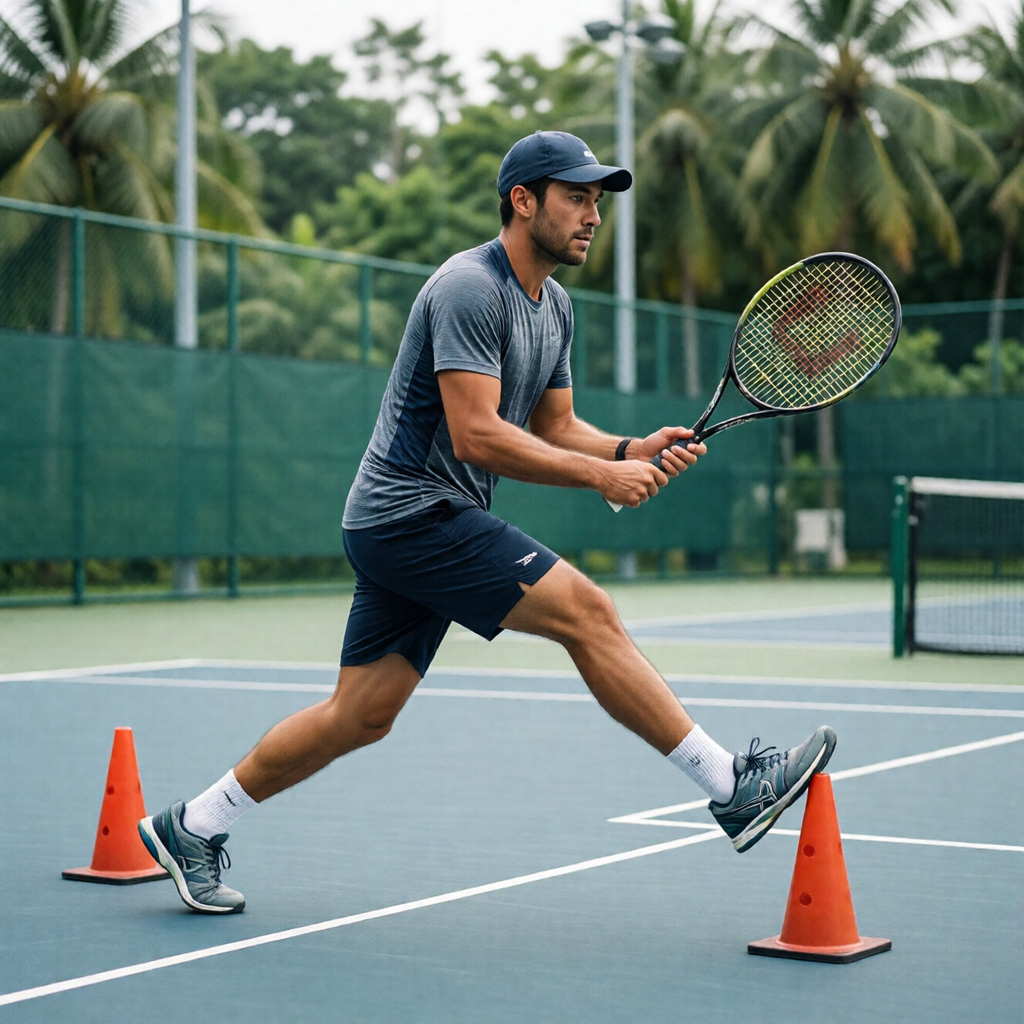
Table of Contents
- Why Tennis Footwork Is Important
- Common Tennis Footwork Problems
- Split-Step Drill
- Side-to-Side Shuffle Drill
- Forward and Backward Movement Drill
- Cone Shadowing Drill
- Lateral Recovery Drill
- Cross-Court Footwork Drill
- How Often Should You Practise Tennis Footwork?
- Improve Your Footwork with Tennis Lessons in Singapore
Why Tennis Footwork Is Important
Tennis is a movement-based sport. Players constantly move forward, backward, sideways and diagonally to reach the ball while maintaining enough balance to execute a controlled shot.
Good tennis footwork helps you:
- Reach the ball earlier
- Maintain better balance during shots
- Prepare your body before hitting
- Recover quickly after each shot
- Create better positioning
- Generate more power from the lower body
- Reduce unnecessary movement
- Respond faster during rallies
One common mistake among recreational players is focusing almost entirely on racket technique. Although stroke technique is important, a technically correct shot is difficult to execute when you are out of position.
For example, a player may have a good forehand but still hit weak or inconsistent shots because they arrive too late or stand too far away from the ball. Improving footwork can help solve this problem.
Common Tennis Footwork Problems
Before starting specific drills, it helps to understand the movement problems that commonly affect tennis players.
Standing Too Flat-Footed
Some players remain stationary while waiting for their opponent’s shot. This makes it harder to react quickly.
The split step helps solve this problem by keeping you ready to move in any direction.
Taking Too Many Small Steps
Small adjustment steps are useful near the ball, but excessive movement can waste energy and cause you to arrive late.
Good footwork combines larger movement steps with smaller adjustment steps.
Failing to Recover
After hitting a shot, players should generally begin recovering towards an appropriate court position rather than watching where their shot goes.
Good recovery movement is particularly important during longer rallies.
Moving Only Sideways
Tennis requires movement in multiple directions. Players need to move laterally, forward and backward, as well as diagonally.
A balanced footwork routine should therefore include different movement patterns.
Split-Step Drill
The split step is one of the most fundamental movements in tennis.
It is a small hop performed around the time your opponent hits the ball. The purpose is to help you react quickly and push off in the appropriate direction.
How to practise
- Stand in your ready position.
- Keep your feet approximately shoulder-width apart.
- Perform a small hop.
- Land lightly on the balls of your feet.
- Immediately move left or right.
- Return to your ready position.
- Repeat the movement.
You can practise this without a ball initially.
Once you become comfortable, have a training partner point or feed the ball to different areas of the court. Perform the split step before moving towards the ball.
The movement should be controlled rather than a large jump. The objective is to stay ready, not to jump high.
Side-to-Side Shuffle Drill
The side-to-side shuffle is useful for developing lateral movement.
How to practise
Place two cones several metres apart.
Start at one cone and assume your tennis ready position. Shuffle sideways towards the other cone while keeping your body facing forward.
Touch or pass the cone, then shuffle back.
Repeat the movement for several repetitions.
Focus on:
- Keeping your knees slightly bent
- Staying low
- Maintaining balance
- Avoiding crossed feet
- Keeping your eyes forward
As your movement improves, increase the speed while maintaining proper technique.
This drill is particularly useful for players who struggle to reach balls hit towards the corners of the court.
Forward and Backward Movement Drill
Tennis players also need to move effectively towards the net and back towards the baseline.
Place two cones on the court to represent your starting and finishing positions.
Begin at the baseline area and move forward using controlled steps. Once you reach the front cone, change direction and move backwards.
When moving backwards, avoid turning completely around unless the situation requires it. Maintain awareness of the court and prepare to change direction.
This drill can help players become more comfortable when transitioning between baseline and net positions.
Cone Shadowing Drill
Cone drills can be used to simulate the unpredictable movement required during tennis.
Place several cones around one side of the court. Your coach or training partner can call out different cones.
When a cone is called, move quickly towards it, perform a controlled shadow swing and recover towards the centre.
For example:
Centre → Forehand Corner → Centre → Backhand Corner → Centre
You can later add forward and backward movements.
The important part is not simply reaching each cone as quickly as possible. You should practise the complete movement pattern:
Ready → Move → Set → Swing → Recover
This makes the drill more relevant to actual tennis.
Lateral Recovery Drill
Recovery is often overlooked by recreational players.
After hitting a shot from one side of the court, you usually need to recover to a suitable position before your opponent hits the next ball.
To practise this, start near the centre of the baseline.
Move towards the forehand side, simulate a forehand stroke and immediately move back towards the centre.
Repeat on the backhand side.
As you improve, you can ask a coach or partner to feed balls to different locations instead of following a predictable pattern.
The goal is to develop the habit of recovering immediately after a shot.
Cross-Court Footwork Drill
Cross-court movement requires players to cover more distance and control their body efficiently.
Start near the centre of the baseline. Move diagonally towards one corner and simulate a groundstroke. Recover back towards the centre before moving diagonally towards the opposite corner.
This drill can improve:
- Acceleration
- Deceleration
- Direction changes
- Balance
- Court coverage
- Recovery movement
Remember that stopping is just as important as accelerating. Reaching the ball quickly is not useful if you cannot control your body before hitting the shot.
How Often Should You Practise Tennis Footwork?
Footwork does not need to be trained for a long period every day.
For recreational players, adding 10 to 15 minutes of focused movement exercises before or after tennis practice can make a useful difference over time.
A simple weekly routine could include:
| Training Area | Suggested Practice |
|---|---|
| Split steps | 5 minutes |
| Lateral movement | 5 minutes |
| Forward/backward movement | 5 minutes |
| Cone drills | 5–10 minutes |
| Recovery movement | 5 minutes |
The key is consistency.
Instead of performing one intense footwork session occasionally, shorter sessions incorporated into regular tennis training can help develop better movement habits.
Players should also adjust training intensity according to their fitness level. Beginners should focus on movement quality before trying to maximise speed.
Improve Your Footwork with Tennis Lessons in Singapore
Improving tennis footwork is easier when you receive feedback from an experienced coach. A coach can identify movement problems that may be difficult to notice yourself, such as standing too upright, taking inefficient steps or failing to recover after a shot.
Tennis lessons can also combine footwork exercises with actual stroke training. This allows players to practise movement in realistic situations instead of simply performing isolated drills.
For beginners, structured coaching can help establish good movement habits from the start. Intermediate players can use more advanced movement drills to improve court coverage, reaction speed and consistency.
Whether you are learning tennis for the first time or looking to improve your existing game, developing better footwork can have a significant impact on your overall performance.
With regular practice, proper technique and suitable tennis coaching, you can become faster around the court, reach more balls and put yourself in a better position to hit effective shots.
Conclusion
Good tennis footwork is about much more than simply running faster. It involves timing, balance, positioning, acceleration, recovery and the ability to change direction efficiently.
Simple exercises such as split steps, lateral shuffles, cone drills and recovery movements can help players develop these skills.
For Singapore tennis players, incorporating footwork training into regular tennis practice is an effective way to build a stronger foundation and become more confident during rallies and matches.