
A strong tennis serve can make a major difference to your overall game. It starts every point and can help you control the pace, direction, and pressure of a match. However, the serve is also one of the more technical strokes to learn because it involves several movements working together.
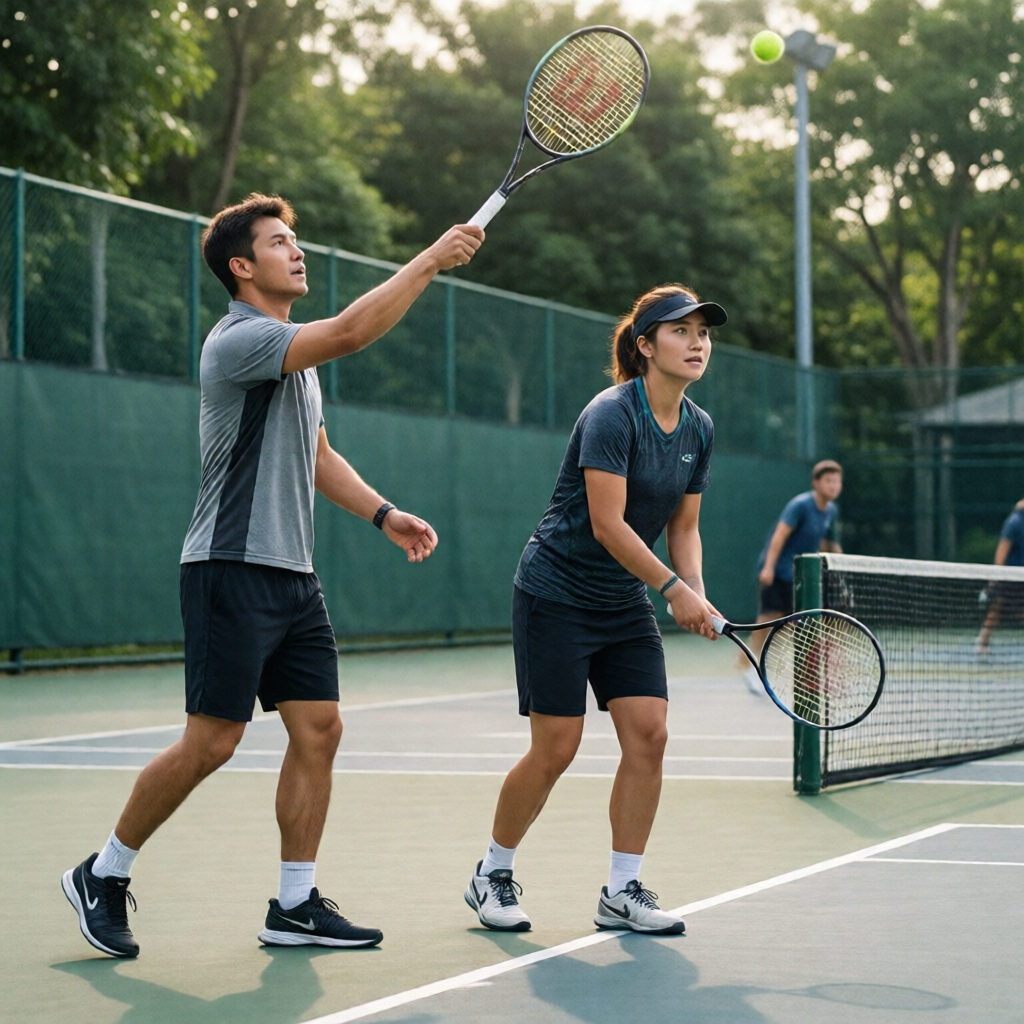
For beginners and developing players, professional tennis coaching can provide structured guidance that is difficult to achieve through practice alone. A tennis coach can identify technical problems, explain the correct movement, and design drills that gradually build a more reliable serve.
If you are attending tennis lessons in Singapore and want to improve your serve, understanding how coaches approach serve development can help you get more from every training session.
Table of Contents
- Why the Tennis Serve Is Difficult to Learn
- Starting With the Correct Serving Technique
- Developing a Consistent Ball Toss
- Improving the Racket Preparation
- Learning to Use the Legs and Body
- Developing Contact Point and Timing
- Understanding Different Types of Serves
- Using Drills to Build Serve Consistency
- How a Tennis Coach Identifies Serving Problems
- Practising Your Serve Between Lessons
- How Long Does It Take to Improve Your Serve?
- Building a More Reliable Serve Through Tennis Coaching
Why the Tennis Serve Is Difficult to Learn
Unlike a forehand or backhand, the serve is normally performed without another player hitting the ball toward you. You control the starting position, toss the ball yourself, coordinate your movement, and make contact at the correct height.
This makes timing especially important.
A small problem with one part of the motion can affect the rest of the serve. For example, an inconsistent toss may cause poor contact, while incorrect racket preparation can reduce power or make it difficult to control direction.
Professional tennis lessons help break the serve into manageable stages. Instead of trying to change everything at once, a coach can focus on one movement before gradually combining the different parts.
Starting With the Correct Serving Technique
Before working on power, players need to establish a reliable serving motion.
A tennis coach will usually look at your stance, grip, preparation, ball toss, racket movement, body rotation, contact point, and follow-through.
For many developing players, the continental grip is an important part of learning an effective serve. It allows the racket to move through different serving motions while providing control over direction and spin.
Your coach can also check whether your starting position is comfortable and balanced.
A technically sound starting position gives you a consistent foundation for the rest of the motion.
Developing a Consistent Ball Toss
The ball toss is one of the most important parts of the tennis serve.
If the ball is tossed too far forward, too far behind, or too far to either side, the player may have to adjust their body position before making contact.
This can make the serve inconsistent.
During tennis coaching, players can practise tossing the ball repeatedly without hitting it. The goal is to develop a predictable toss that reaches a comfortable contact area.
A coach may also observe the height, direction, and position of your toss and provide corrections.
Practising the toss separately can be particularly useful for beginners because it allows you to develop consistency without worrying about the entire serving motion.
Improving the Racket Preparation
The racket preparation phase helps set up the acceleration toward the ball.
Many beginners try to generate power mainly by moving their arm quickly. However, an effective serve involves coordinated movement throughout the body rather than simply swinging the arm harder.
A tennis coach can demonstrate how the racket should move during the preparation phase and how the upper body, shoulders, and arm work together.
The objective is to create a smooth movement rather than a rushed swing.
When your preparation becomes more consistent, it becomes easier to repeat the same motion under pressure.
Learning to Use the Legs and Body
Serving is not only an upper-body movement.
The legs and body help generate momentum and contribute to the overall serving motion. Players who rely entirely on their arm may struggle to produce controlled power and may develop inefficient movement patterns.
Professional tennis coaching can introduce the use of the knees, hips, shoulders, and trunk in a progressive way.
For beginners, the focus should not simply be on hitting the ball as hard as possible. The priority is learning how the different parts of the body work together.
Once the movement becomes comfortable, players can gradually develop more racket-head speed and serve pace.
Developing Contact Point and Timing
The racket needs to meet the ball at an appropriate position for the intended serve.
Contact point affects direction, height, and the quality of the shot. Poor timing can cause the ball to travel into the net, go long, or move away from the intended target.
A coach can help you understand where and when contact should occur.
Instead of repeatedly serving without feedback, structured tennis lessons allow you to make adjustments and immediately test them.
This type of repetition can make practice more productive because you are not simply repeating the same movement—you are working toward a specific technical improvement.
Understanding Different Types of Serves
As your technique develops, tennis coaching can introduce different types of serves.
Flat Serve
A flat serve is generally associated with a direct path and higher pace. Players often use it when they want to put pressure on an opponent with speed.
Slice Serve
A slice serve uses sidespin to create movement after the ball bounces. It can be useful for changing the direction and shape of your serve.
Kick Serve
The kick serve uses topspin and other spin characteristics to create a higher bounce. It requires more advanced technique and coordination.
Beginners do not necessarily need to master every serve immediately.
A coach can determine when you are ready to introduce additional serve variations based on your technique and consistency.
Using Drills to Build Serve Consistency
Serve improvement requires repetition, but simply hitting hundreds of serves is not always the most effective approach.
Tennis coaches can use specific drills based on your current weaknesses.
For example, a training session may focus on:
- Ball toss consistency
- Serving from a shortened motion
- Target serving
- Contact point
- Racket acceleration
- Serving to different areas
- First-serve and second-serve routines
- Serve placement under pressure
Target drills can be especially useful because they teach players to think about placement rather than simply hitting the ball over the net.
Instead of measuring success only by speed, you can track how often your serves reach the intended target.
How a Tennis Coach Identifies Serving Problems
One advantage of professional tennis lessons is immediate feedback.
A player may know that their serve is inconsistent without understanding why. A coach can observe the complete movement and identify areas that need attention.
Common problems may include:
- Inconsistent ball toss
- Incorrect grip
- Poor balance
- Rushing the motion
- Limited body rotation
- Inconsistent contact point
- Insufficient follow-through
- Trying to generate too much power too early
- Lack of a reliable second serve
A coach can then introduce appropriate corrections instead of asking the player to change everything simultaneously.
This makes the learning process more structured.
Practising Your Serve Between Lessons
Regular practice outside your tennis lessons can help reinforce what you learn during coaching sessions.
However, quality is more important than simply hitting a large number of serves.
For example, you could spend a short practice session working on your ball toss before progressing to full serves. Another session could focus on serving toward specific targets.
If you have access to a tennis court, practising both first and second serves can also help you develop greater confidence.
Players should pay attention to technique rather than concentrating entirely on speed.
If you repeatedly practise an incorrect movement, it can become a habit. When possible, use the technical points discussed with your coach as a guide for your independent practice.
How Long Does It Take to Improve Your Serve?
There is no fixed number of tennis lessons required to develop a good serve.
Progress depends on factors such as your previous experience, coordination, practice frequency, physical condition, technique, and consistency of training.
A beginner may first focus on producing a legal serve consistently. Later, the focus can move toward placement, spin, speed, and tactical use.
Regular tennis lessons can provide a clear progression from basic serving mechanics to more advanced match situations.
The important goal is not to rush through the stages. A reliable foundation can make later improvements much easier.
Building a More Reliable Serve Through Tennis Coaching
Improving your tennis serve involves much more than hitting the ball harder.
A reliable serve comes from coordinating the grip, stance, toss, racket preparation, body movement, contact point, and follow-through. Once these fundamentals become more consistent, players can begin developing greater pace, spin, accuracy, and tactical variety.
Professional tennis coaching can make this process more structured by providing demonstrations, drills, corrections, and feedback based on your individual technique.
For players attending tennis lessons in Singapore, regular serve-focused training can become an important part of long-term development. Whether you are learning your first proper serve or trying to improve an existing one, working through each stage systematically can help you build a serve that is more consistent and useful during real matches.
The key is to focus on good technique first, practise consistently, and gradually turn the movements learned during tennis coaching into a natural part of your game.