
Hitting the tennis ball consistently is an important milestone, but being able to control where the ball goes can take your game to another level. Shot placement allows players to move opponents, create space and make better decisions during rallies.
Many beginners naturally focus on hitting the ball over the net. As their skills improve, tennis lessons can introduce a more advanced question: Where should you hit the ball?
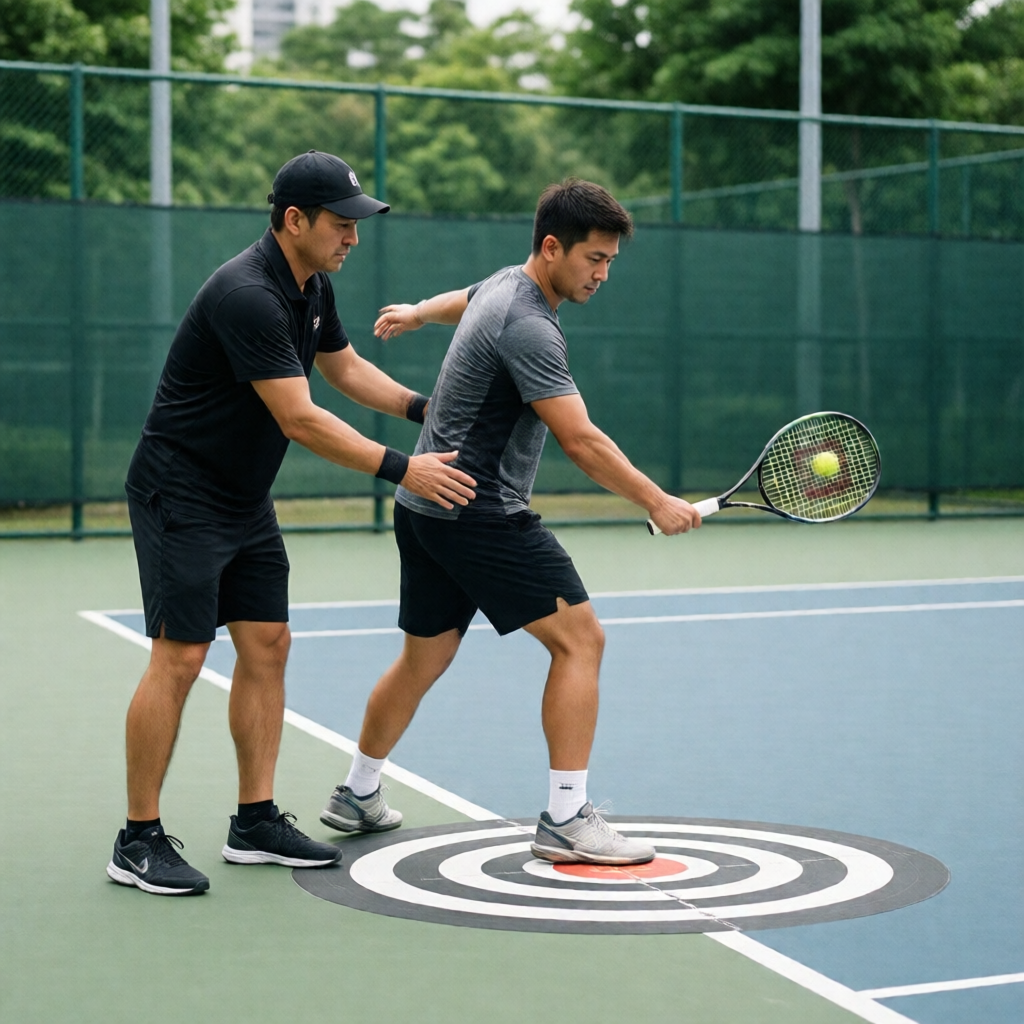
Professional tennis coaching can help players develop better control through technique, footwork, target drills and realistic point situations. Instead of simply hitting harder, players learn how direction, depth and consistency can influence a rally.
Table of Contents
- Why Shot Placement Matters in Tennis
- Understanding Direction and Target Areas
- Developing Better Cross-Court Shots
- Learning to Hit Down the Line
- Improving Depth and Control
- Using Angles to Move Your Opponent
- How Footwork Affects Shot Placement
- Practising Placement During Tennis Lessons
- Choosing the Right Shot During a Rally
- Avoiding Common Shot Placement Mistakes
- Practising Shot Placement Between Lessons
- How Coaches Help Players Improve Accuracy
- Final Thoughts
Why Shot Placement Matters in Tennis
A powerful tennis shot is not necessarily an effective tennis shot.
A ball hit hard directly toward an opponent may allow them to respond comfortably. A slower but better-placed shot can sometimes create a much more difficult situation.
Shot placement can help you:
- Move your opponent around the court
- Create open spaces
- Control rally patterns
- Reduce unnecessary errors
- Build attacking opportunities
- Defend more effectively
- Change the rhythm of a point
For beginners, the first objective should still be consistency. However, once a player can keep the ball in play, tennis lessons can gradually introduce greater directional control.
Understanding Direction and Target Areas
Before improving placement, players need to understand the basic target areas of a tennis court.
Common targets include:
- Cross-court
- Down the line
- Deep to the baseline
- Short into the court
- Wide toward the sideline
- Toward the opponent’s body
Each target creates a different tactical situation.
During tennis coaching, a coach may place targets on the court or use cones to give players a clear visual objective.
Rather than simply saying “hit the ball better,” the player has a specific goal.
For example, a drill may require ten forehands to land deep cross-court. This develops both accuracy and consistency.
Developing Better Cross-Court Shots
Cross-court shots are among the most useful patterns for developing players.
Because the ball travels diagonally across the court, there is generally more distance available for the ball to travel before reaching the opposite sideline. This can provide a useful margin for error.
Tennis lessons can use cross-court drills to develop:
- Directional control
- Rally consistency
- Spin
- Depth
- Recovery movement
A coach can also teach players to recover after hitting the shot rather than watching the ball.
This creates a complete movement pattern:
Prepare → Hit → Recover → Prepare again
The player is therefore developing both shot placement and court positioning at the same time.
Learning to Hit Down the Line
Down-the-line shots can be more demanding because the available court area is narrower.
Players need good timing, preparation and control to change direction successfully.
A coach may introduce this shot gradually.
First, the player might practise hitting down the line from a stationary position. Later, movement can be added. Eventually, the player can practise choosing between cross-court and down-the-line shots during live points.
The objective is not to hit down the line constantly.
Instead, players learn to recognise when changing direction makes sense.
Improving Depth and Control
Placement is not only about left and right.
Depth is equally important.
A deep shot can push an opponent toward the baseline, while a shorter shot may bring them forward.
During tennis lessons, players can practise hitting to different depth targets.
For example, a coach can divide the court into target zones and ask the player to alternate between:
- Deep rally balls
- Medium-depth shots
- Short attacking balls
This helps players understand how much racket speed, spin and trajectory are required for different targets.
Over time, the player develops better control over the length of their shots.
Using Angles to Move Your Opponent
Angled shots can make an opponent move significantly farther than a straight shot.
For example, hitting a ball toward the sideline can force the opponent away from the centre of the court. This may create open space for the next shot.
However, angles require control.
A player who attempts aggressive angles without sufficient technique may produce unnecessary errors.
Professional tennis coaching can help players learn how to create angles progressively. Coaches can start with simple feeding exercises before introducing movement and competitive point situations.
How Footwork Affects Shot Placement
Poor footwork can make accurate placement difficult.
If you arrive late to the ball, you may be forced to hit from an awkward position. This can reduce your ability to control direction and depth.
Good footwork allows you to:
- Reach the ball earlier
- Establish balance
- Prepare the racket correctly
- Contact the ball at a comfortable point
- Recover after hitting
This is why shot placement should not be trained separately from movement.
A tennis coach can observe whether inaccurate shots are caused by the swing itself or by the player’s position when making contact.
Practising Placement During Tennis Lessons
A structured tennis lesson can turn shot placement into a measurable skill.
Instead of hitting without a target, players can work toward specific objectives.
A coach might create exercises such as:
Drill 1: Cross-Court Accuracy
Hit a series of forehands into a designated cross-court target.
Drill 2: Direction Change
Hit several cross-court shots before attempting one down the line.
Drill 3: Depth Control
Alternate between deep and shorter target areas.
Drill 4: Moving Target
The coach changes the feeding location so the player must adjust both footwork and placement.
Drill 5: Live Points
The player earns points for successfully hitting designated target areas during rallies.
These exercises gradually move from technical repetition toward real match situations.
Choosing the Right Shot During a Rally
Good placement is not simply about accuracy.
It is also about decision-making.
A player may have the ability to hit down the line but still need to decide whether it is the appropriate option.
Factors to consider include:
- Where your opponent is standing
- Where you are positioned
- Whether the ball is high or low
- How much time you have
- Whether you are balanced
- Whether you are attacking or defending
For example, attempting a sharp angle while stretched outside the court may be unnecessarily risky.
Tennis lessons can help players understand these situations through repeated point-based drills.
Avoiding Common Shot Placement Mistakes
Developing players often make several placement mistakes.
Trying to Hit Too Close to the Lines
Targets near the lines provide little margin for error. Players should first develop consistency before attempting extremely precise shots.
Changing Direction Too Often
Changing from cross-court to down the line can be effective, but doing it on every shot can create errors.
Ignoring Opponent Position
A perfectly executed shot may be ineffective if it goes directly toward an opponent who is already waiting there.
Focusing Only on Power
More racket speed does not automatically produce better placement. Control and timing are equally important.
Forgetting Recovery Position
After hitting a well-placed shot, players still need to prepare for the opponent’s response.
Practising Shot Placement Between Lessons
You can continue developing placement when practising with a partner.
Set specific targets rather than simply rallying.
For example, spend ten minutes working on cross-court consistency, followed by ten minutes on depth. You can then finish with points where you attempt to apply those patterns naturally.
If you have access to a tennis ball machine, target-based drills can also be useful.
The key is to make each practice session purposeful.
Even a short session with a clear placement objective can reinforce what you learned during tennis coaching.
How Coaches Help Players Improve Accuracy
One of the main advantages of tennis lessons is immediate feedback.
A coach can identify whether a placement problem comes from:
- Incorrect racket preparation
- Poor contact point
- Inconsistent swing path
- Poor footwork
- Incorrect timing
- Excessive racket speed
- Lack of follow-through
- Poor decision-making
The solution depends on the cause.
For example, if a player repeatedly sends the ball long, simply telling them to “hit softer” may not solve the underlying problem. The coach may instead identify an issue with racket angle, contact point or swing control.
This makes targeted coaching valuable for developing accuracy.
Final Thoughts
Better shot placement can make tennis more controlled, strategic and enjoyable.
For beginners, the first priority should be learning to keep the ball in play. As consistency improves, tennis lessons can introduce directional control, depth, angles and tactical decision-making.
Professional coaching can help players understand not only how to hit the ball, but also where and when to hit it.
With regular tennis lessons and focused practice, players can gradually develop the ability to choose better targets, move opponents around the court and build more effective points.
The goal is not to make every shot perfect. It is to develop enough control that your shot selection becomes a deliberate part of your tennis game.