
Reaching an intermediate level in tennis is an important milestone. You can rally with greater consistency, understand the basic strokes, serve reasonably well, and play points without needing to think about every movement.
However, progressing beyond the intermediate stage can sometimes be difficult.
At this level, simply hitting more balls may not be enough. You need to understand how to use your existing skills more effectively, identify weaknesses in your game, and develop techniques that work under match pressure.
This is where structured tennis lessons can be particularly useful. A professional tennis coach can assess your current game and help you determine which areas should receive the most attention.
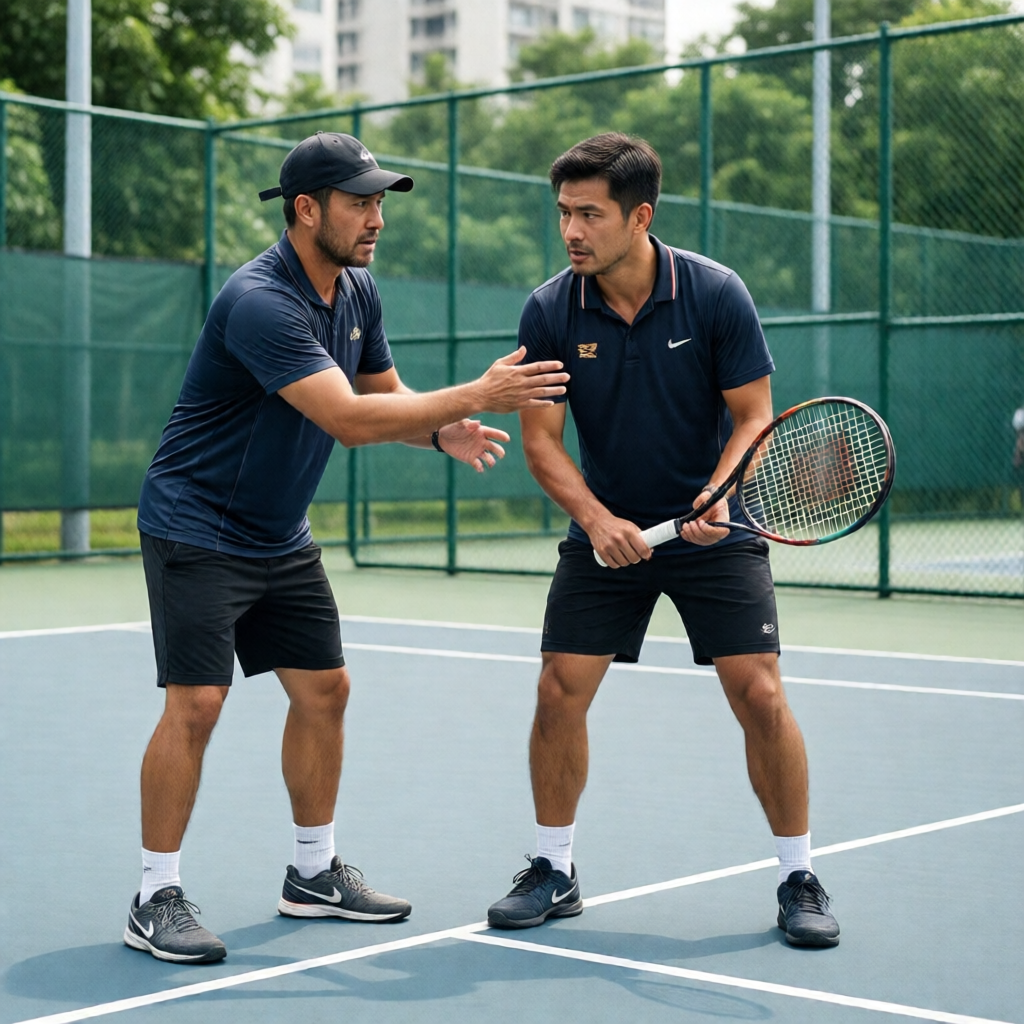
Whether you play recreationally or want to become more competitive, knowing what to work on next can make your tennis training more focused and productive.
Table of Contents
- Understanding Your Current Tennis Level
- Improve Stroke Consistency Under Pressure
- Develop Better Footwork and Court Movement
- Work on Serve and Return
- Improve Shot Placement
- Learn to Build Points Strategically
- Strengthen Your Weaker Side
- Improve Transition From Defence to Attack
- Practise Match Situations
- Use Tennis Lessons to Identify Technical Problems
- Create a Personal Training Plan
- When Should an Intermediate Player Move to Advanced Training?
- Final Thoughts
Understanding Your Current Tennis Level
Before deciding what to work on next, it is useful to understand what is already working well in your game.
An intermediate player may have reasonably consistent groundstrokes but struggle with movement. Another player may have a strong forehand but an unreliable backhand or second serve.
There is no single training programme that is ideal for every intermediate player.
During tennis coaching, your coach can observe your strokes, movement, serve, return, shot selection, and performance during points. This can help identify the areas that are limiting your progress.
Instead of spending every lesson practising your favourite stroke, you can use your training time to address the parts of your game that need the most development.
Improve Stroke Consistency Under Pressure
At the intermediate level, players often have technically acceptable forehands and backhands but struggle to reproduce them when rallies become faster.
A stroke that works well during a relaxed drill may become inconsistent when you are under pressure.
Intermediate tennis lessons can introduce more demanding rally situations. Your coach may vary the pace, depth, direction, and height of the incoming ball.
This teaches you to adjust rather than expecting every ball to arrive in the same position.
The goal is to develop strokes that remain reliable when the point becomes unpredictable.
Consistency is especially important because reducing unforced errors can change the way you approach matches.
Develop Better Footwork and Court Movement
Good strokes are easier to produce when you arrive at the ball in the right position.
Intermediate players often discover that their technique breaks down because they are late rather than because the stroke itself is fundamentally wrong.
Footwork training can help improve your ability to:
- Recover after each shot
- Move forward and backward efficiently
- Reach wider balls
- Adjust to different bounce heights
- Maintain balance during shots
- Return to a good court position
A tennis coach can also help identify inefficient movement patterns.
Rather than simply running faster, the objective is to move efficiently and arrive in a balanced position that allows you to execute the next shot.
Work on Serve and Return
Serve and return become increasingly important as players progress.
At beginner level, the main objective may simply be getting the serve into the correct service box. Intermediate players can begin focusing more on placement, variation, and the ability to start a point with a specific intention.
For example, you may work on serving toward different areas of the service box depending on the opponent’s position.
The return deserves similar attention.
A reliable return can immediately put pressure on an opponent and prevent them from controlling the point with their serve.
Tennis lessons can combine serve and return drills with realistic point situations so that these skills become easier to use during matches.
Improve Shot Placement
Intermediate players often focus heavily on power.
However, hitting the ball harder is not always the most effective way to improve your results.
Shot placement can be just as important.
During tennis coaching, you can practise directing the ball toward specific areas of the court. These may include:
- Cross-court targets
- Down-the-line targets
- Deep areas near the baseline
- Short angles
- Open court spaces
- An opponent’s weaker side
Learning to control direction gives you more options during rallies.
Instead of hitting every shot with the same intention, you begin to understand how placement can influence what happens next.
Learn to Build Points Strategically
One major difference between beginner and intermediate tennis is point construction.
Beginners often react to each incoming ball individually. Intermediate players can start thinking several shots ahead.
For example, you might use a deep cross-court shot to move your opponent before looking for an opportunity to attack the open court.
This does not mean every point needs to follow a complicated plan.
Instead, tennis coaching can help you understand basic tactical concepts such as creating space, changing direction, controlling depth, and recognising when to attack.
The aim is to make your shot selection more intentional.
Strengthen Your Weaker Side
Most players naturally have a preferred stroke.
For many right-handed players, the forehand may feel more comfortable than the backhand. Other players may have the opposite experience.
At intermediate level, opponents may deliberately target your weaker side.
This makes it important to develop enough confidence on both sides of the court.
Your tennis coach can identify weaknesses in your backhand technique, movement, preparation, or timing and introduce drills specifically designed to improve them.
The objective does not necessarily have to be turning your weaker stroke into your strongest weapon.
Instead, you want it to become reliable enough that opponents cannot easily exploit it.
Improve Transition From Defence to Attack
Intermediate players also need to learn when to move from defence into attack.
When you are pushed toward the edge of the court, the safest option may be to return a high, deep ball and recover your position.
When your opponent gives you a shorter ball, however, you may have an opportunity to move forward and take control.
Recognising these situations is an important part of tennis development.
Coaches can create drills that simulate defensive, neutral, and attacking situations. This allows players to practise choosing an appropriate response rather than simply hitting predetermined shots.
Practise Match Situations
Technical drills are useful, but intermediate players also need to apply their skills during points.
This is why match-based tennis training can become increasingly important.
A coach may create situations such as:
- Starting a point with a serve
- Playing only cross-court rallies
- Attacking a short ball
- Defending against an aggressive player
- Playing points from a disadvantageous position
- Protecting a lead
- Playing important points under pressure
These situations help connect technical training with actual match performance.
You may discover that a stroke that looks good during a drill requires further work when you have to use it while making tactical decisions.
Use Tennis Lessons to Identify Technical Problems
Intermediate players sometimes develop habits that are difficult to notice without outside feedback.
You may feel that your forehand is technically correct while consistently hitting the ball late. You may also believe that your serve needs more power when the real issue is timing or ball toss consistency.
A tennis coach can observe these details during training and explain what is happening.
Video analysis can also be useful when available, particularly for movements that are difficult to recognise while playing.
The goal is to understand why a problem occurs rather than simply trying to hit the ball harder or practise the same movement repeatedly.
Create a Personal Training Plan
Once you understand your strengths and weaknesses, you can create a more focused training plan.
For example, an intermediate player might divide training into several areas:
Technique: Improve backhand preparation and serve mechanics.
Movement: Practise recovery steps and lateral movement.
Tactics: Develop point construction and shot selection.
Match play: Play practice sets and specific point situations.
Independent practice: Repeat selected drills between coached sessions.
A structured approach can make tennis lessons more productive because every session has a clear purpose.
Your priorities can also change over time. Once a weakness improves, you can move your attention to another part of your game.
When Should an Intermediate Player Move to Advanced Training?
There is no single point at which every player becomes advanced.
Progress depends on consistency, match experience, technical ability, movement, tactical understanding, and confidence.
An intermediate player may be ready for more advanced training when they can maintain rallies reliably, serve and return consistently, move efficiently around the court, and apply basic tactics during competitive points.
At that stage, training can become more specialised.
Instead of spending most of the lesson learning fundamental movements, you may spend more time developing tactical patterns, advanced shot variations, match strategy, and performance under pressure.
Your coach can help determine when this transition makes sense based on your actual playing ability.
Final Thoughts
Intermediate tennis players are often at a stage where focused training can make a significant difference.
The next step is not necessarily learning more complicated techniques. It is about making your existing skills more reliable and learning how to use them effectively during points.
Tennis lessons can help intermediate players work on stroke consistency, footwork, serve and return, shot placement, point construction, weaker strokes, and match situations.
Instead of trying to improve everything simultaneously, identify the areas that have the greatest effect on your game and build your training around them.
With regular tennis coaching and purposeful practice, intermediate players can gradually turn individual tennis skills into a more complete and reliable game.