
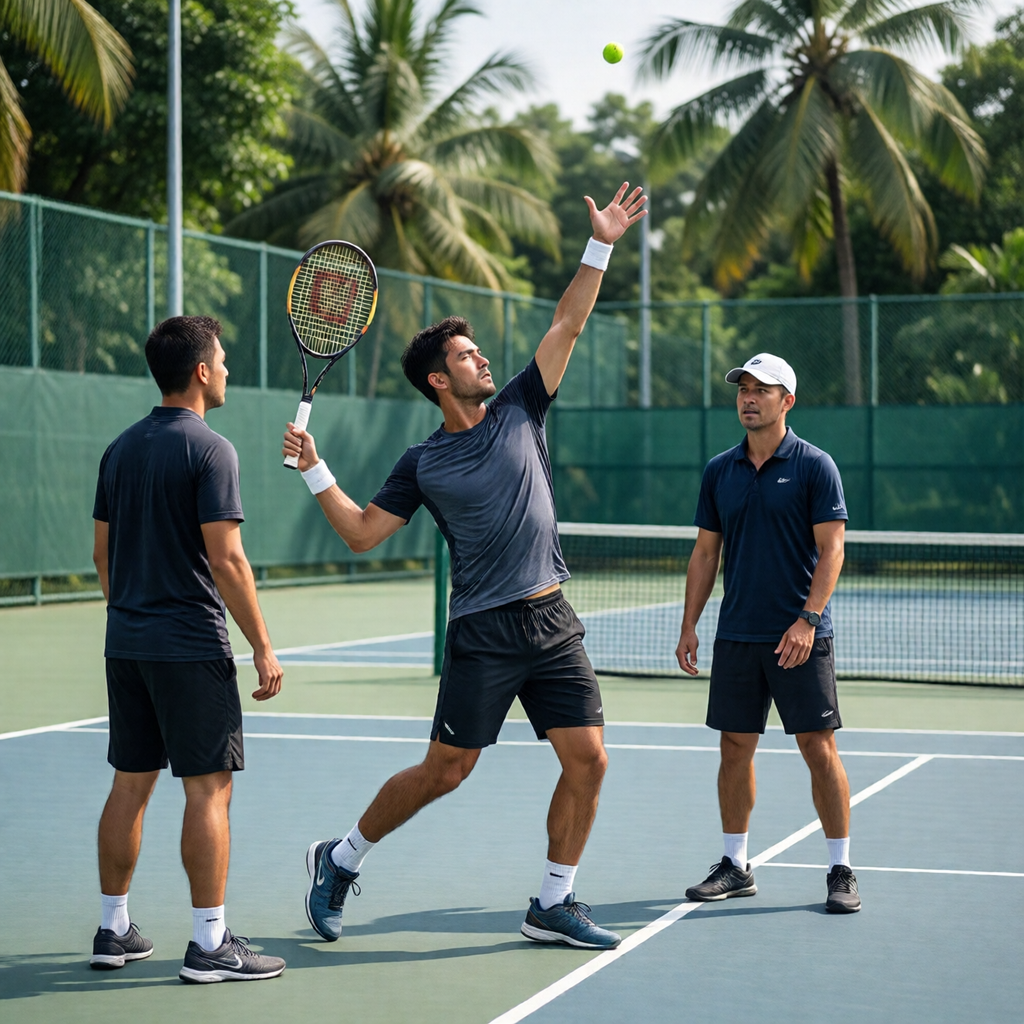
The tennis serve is one of the most important shots in the game, but it is also one of the most technically demanding. Unlike a forehand or backhand, the serve starts with the player controlling the ball before making contact.
A good serve requires coordination between the legs, hips, shoulders, arm, wrist and racket. Even a small technical problem can affect accuracy, power and consistency.
For recreational players attending tennis lessons Singapore, improving the serve can provide a major boost in confidence and overall match performance.
The good news is that many common serving problems can be corrected with the right technique and regular practice.
Table of Contents
- Why the Tennis Serve Is Important
- Common Serve Mistakes
- Inconsistent Ball Toss
- Poor Serving Stance
- Using Too Much Arm
- Dropping the Racket Too Early
- Incorrect Contact Point
- Trying to Hit Too Hard
- Falling Away During the Serve
- Poor Follow-Through
- Practising Serve Placement
- How to Build a Better Serve
- How Tennis Coaching Can Help
- Conclusion
Why the Tennis Serve Is Important
The serve starts every point and gives the server the first opportunity to control the rally.
A consistent serve can help you:
- Start points confidently
- Put pressure on your opponent
- Earn free points
- Control the direction of the first rally
- Set up your next shot
- Reduce double faults
However, recreational players often focus too much on speed.
A powerful serve is useful, but a reliable serve that lands consistently in the service box is usually more valuable than a very fast serve that frequently results in faults.
Developing accuracy and repeatability should come before maximum power.
Common Serve Mistakes
Many serving problems come from a small number of common technical errors.
Some of the most frequent include:
- Inconsistent ball toss
- Incorrect stance
- Poor racket preparation
- Using only the arm
- Incorrect contact point
- Excessive power
- Poor balance
- Incomplete follow-through
Identifying the specific problem is important because simply practising more may not solve a technical issue.
Inconsistent Ball Toss
The ball toss is one of the most important parts of the serve.
If the ball is tossed too far forward, too far behind or too far to the side, you may need to adjust your body during the swing.
This can make the serve inconsistent.
How to improve it
Start by practising the toss without hitting the ball.
Stand in your normal serving position and repeatedly toss the ball to approximately the same location.
The objective is to develop a predictable toss.
Do not worry about hitting the ball at first.
A consistent toss gives you a stable starting point for the rest of the serving motion.
Poor Serving Stance
Your stance provides the foundation for the serve.
Beginners sometimes stand too rigidly or position their feet incorrectly.
A comfortable serving stance should allow you to transfer energy from the lower body into the upper body.
Your exact stance can depend on your serving technique and coaching style.
The important points are:
- Maintain balance
- Avoid unnecessary tension
- Position your feet consistently
- Keep your body relaxed
- Prepare your body for rotation
Practising the stance without hitting the ball can help make the setup more automatic.
Using Too Much Arm
A common misconception is that a powerful serve comes mainly from swinging the arm harder.
In reality, an effective serve uses the entire body.
Power can come from a combination of:
- Leg drive
- Hip rotation
- Shoulder rotation
- Arm acceleration
- Racket speed
- Timing
If you rely almost entirely on your arm, you may generate less power while creating unnecessary tension.
Instead of trying to force the racket through the ball, focus on a smooth sequence of movements.
Dropping the Racket Too Early
During the serve, the racket needs to move through a coordinated preparation sequence.
Some recreational players rush this movement and lose the correct racket position before contact.
A coach can help you understand how the racket should move during the preparation phase.
Practising slowly can be useful.
Perform the serving motion at half speed and concentrate on the sequence.
Once the movement becomes more comfortable, gradually increase the speed.
Incorrect Contact Point
The racket should meet the ball at an appropriate contact point above your head.
If you contact the ball too low, too far behind or too far to the side, it can affect both direction and power.
Your contact point also needs to work together with your ball toss.
This is why practising the toss and serve as separate movements can be useful for beginners.
Try to develop a predictable toss first before focusing on maximum racket speed.
Trying to Hit Too Hard
One of the biggest mistakes recreational players make is attempting to serve as hard as possible.
When you focus entirely on power, several problems can appear:
- The toss becomes inconsistent
- Technique becomes rushed
- Balance decreases
- Accuracy suffers
- Double faults increase
Instead, start by serving at a controlled pace.
Aim for a high percentage of successful serves.
Once you can consistently land your serves in the correct area, gradually increase speed.
Falling Away During the Serve
A good serve requires balance.
Some players lean or fall sideways during the motion because they are trying to generate extra power.
This can affect accuracy and make it difficult to recover for the next shot.
After completing the serve, you should be able to move naturally into your next position.
Practise landing in balance rather than simply trying to jump as high as possible.
Poor Follow-Through
The serve does not end immediately after contact.
A complete follow-through helps maintain the natural flow of the movement.
Stopping the racket suddenly can create tension and reduce control.
Allow the racket to continue naturally after contact.
Your coach can assess whether your follow-through matches the rest of your serving motion.
Practising Serve Placement
Once your basic technique is becoming reliable, start working on placement.
You can divide the service box into several target areas.
For example:
- Wide
- Body
- Centre
Practise hitting each target repeatedly.
Start with large target areas.
As your accuracy improves, make the targets smaller.
This develops control without requiring maximum power.
First Serve and Second Serve
Intermediate players should eventually develop different serving options.
The first serve can be used to apply pressure with greater speed or more aggressive placement.
The second serve needs to prioritise reliability.
A second serve that consistently lands in the service box is extremely important because missing the second serve results in a double fault.
Depending on your playing level, you may eventually learn different types of serves, such as:
- Flat serve
- Slice serve
- Kick serve
Each type provides different options for controlling the point.
A Simple Serve Practice Routine
You can structure a serving session around different objectives.
Stage 1: Ball Toss
Practise 10–20 controlled tosses.
Stage 2: Shadow Serve
Perform the serving motion without hitting a ball.
Stage 3: Controlled Serves
Hit serves at approximately 60–70% power.
Stage 4: Target Practice
Aim for different areas of the service box.
Stage 5: Match Simulation
Serve two balls and play out the point.
This progression allows you to move from technique to practical application.
How Tennis Coaching Can Help
The tennis serve is difficult to analyse by yourself because much of the movement happens quickly.
You may know that something feels wrong without knowing exactly what needs to change.
A coach can observe your entire serving motion and identify the source of the problem.
For example, what appears to be a power problem may actually be caused by an inconsistent ball toss.
Similarly, a player experiencing frequent double faults may need to improve preparation and rhythm rather than simply practise hitting harder.
Professional tennis lessons Singapore can provide personalised feedback and structured serve training based on your current ability.
Avoid Changing Too Many Things at Once
When improving your serve, make one technical change at a time.
Trying to simultaneously change your grip, stance, toss, racket preparation and follow-through can make the movement feel confusing.
Instead, work on one priority.
For example:
Week 1: Ball toss
Week 2: Preparation
Week 3: Contact point
Week 4: Placement
Once each element becomes more comfortable, combine them into the complete serving motion.
Conclusion
The tennis serve can take time to develop because it involves many coordinated movements.
Common problems such as an inconsistent toss, poor balance, excessive arm use and trying to hit too hard can all affect serve performance.
The best approach is to focus on repeatable technique before chasing maximum speed.
Practise your toss, develop a controlled serving motion, work on placement and gradually introduce more power as your consistency improves.
If you are looking for tennis lessons Singapore, professional coaching can help identify technical problems and provide targeted exercises to develop a more reliable and effective serve.
With regular practice and the right guidance, your serve can become one of the strongest and most dependable parts of your tennis game.