
Reaching an intermediate level in tennis is an exciting stage. You can already rally, understand the basic strokes and keep a point going, but you may feel that your improvement has started to slow down.
This is often because intermediate tennis requires more than simply learning the basic forehand, backhand and serve. Players need to develop consistency, movement, shot selection, court positioning and the ability to use their techniques effectively during actual points.
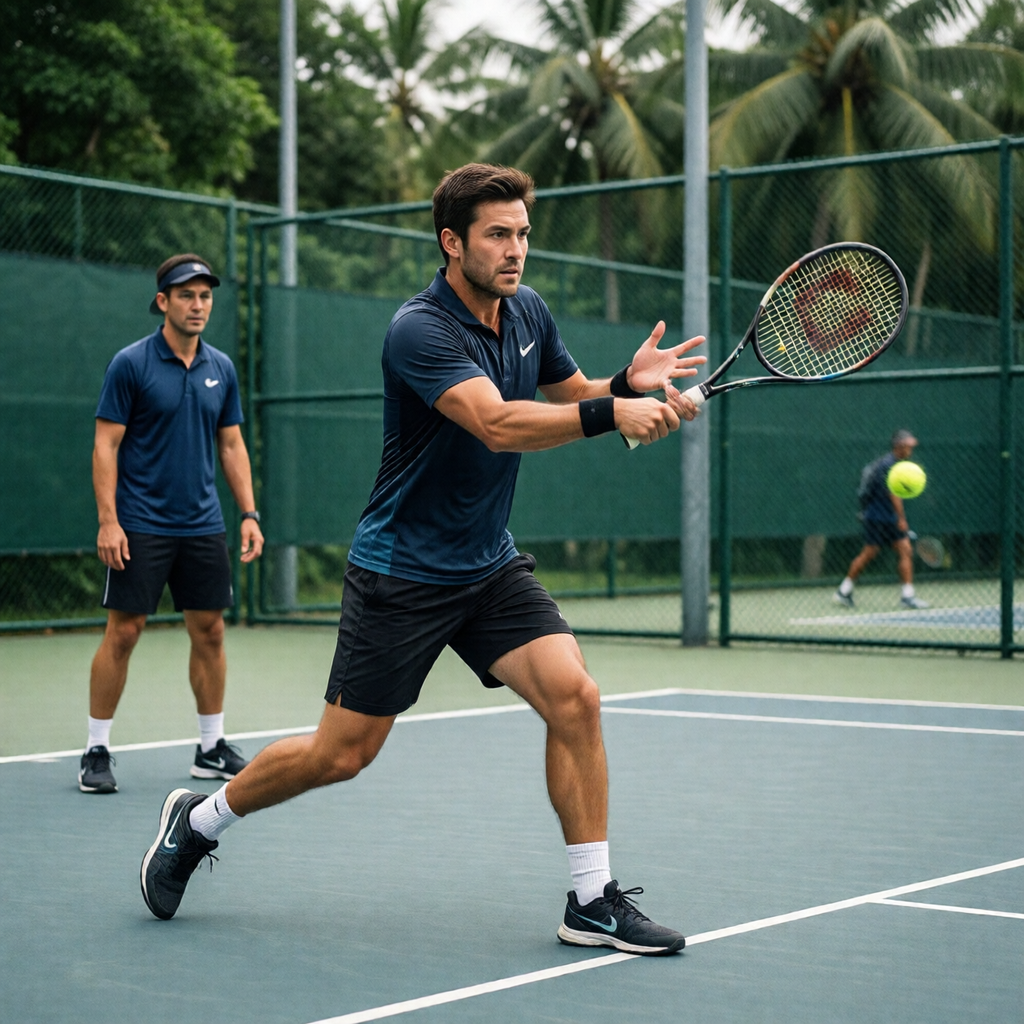
For players attending tennis lessons Singapore, intermediate training should gradually move beyond basic stroke development and focus more on applying skills under realistic match conditions.
Table of Contents
- What Defines an Intermediate Tennis Player?
- Improve Stroke Consistency
- Develop Better Footwork
- Improve Your Serve
- Work on the Return of Serve
- Learn to Attack Short Balls
- Develop Your Net Game
- Improve Court Positioning
- Learn Point Construction
- Practise Under Match Pressure
- Build Physical Fitness
- How Coaching Can Help Intermediate Players
- Conclusion
What Defines an Intermediate Tennis Player?
An intermediate tennis player usually has a basic understanding of the major tennis strokes.
You may already be able to:
- Rally from the baseline
- Hit forehands and backhands
- Serve into the correct service box
- Keep score
- Understand basic tennis rules
- Move around the court
- Play recreational matches
However, intermediate players often experience inconsistency.
One rally may include several excellent shots, followed by an unforced error on a relatively easy ball.
This is where structured training becomes particularly useful.
Instead of simply learning how to hit the ball, you need to learn how to hit the right shot at the right time.
Improve Stroke Consistency
Consistency should be one of the main priorities for intermediate players.
You do not necessarily need to hit harder.
A reliable shot that lands deep in the court can often be more effective than a powerful shot that frequently goes out.
During training, work on:
- Contact point
- Racket preparation
- Follow-through
- Balance
- Spin
- Height over the net
- Depth
- Direction
Try to develop a repeatable swing.
Your goal should be to make your forehand and backhand reliable enough that you can use them repeatedly during a rally.
Develop Better Footwork
As your technique improves, your footwork becomes increasingly important.
Intermediate players should work on reaching the ball early enough to hit from a comfortable position.
Useful footwork skills include:
Split Step
Use the split step as your opponent makes contact with the ball.
Lateral Movement
Practise moving efficiently from side to side.
Recovery
After hitting a shot, immediately begin moving towards an appropriate recovery position.
Direction Changes
Learn to accelerate, slow down and change direction without losing balance.
Good footwork can make your existing strokes more effective without changing your actual swing.
Improve Your Serve
The serve is one of the most important areas for intermediate players to develop.
At beginner level, the main goal is usually getting the ball into the service box.
At intermediate level, you can start developing a more reliable and strategic serve.
Work on:
- Ball toss consistency
- Contact point
- Body rotation
- Racket acceleration
- Placement
- Spin
- Recovery after serving
Instead of always serving towards the same area, practise different targets.
For example, you can practise serving:
- Wide
- Towards the body
- Down the middle
Learning to vary your serve makes it more difficult for your opponent to predict your next shot.
Work on the Return of Serve
The return of serve is another important area that intermediate players sometimes neglect.
A good return does not always need to be aggressive.
The first objective is to get the ball back into play while maintaining a good position.
Practise returning different types of serves, including:
- Fast serves
- Slow serves
- Wide serves
- Body serves
- Kick serves
- Slice serves
Your preparation needs to be quick because you have less time to react to a serve than a normal groundstroke.
A shorter backswing can often help when returning faster serves.
Learn to Attack Short Balls
Intermediate players should learn to recognise opportunities.
When your opponent hits a short ball, you should be able to move forward and take advantage of it.
A basic attacking sequence might be:
Recognise → Move forward → Prepare → Hit deep → Recover or approach
Avoid simply hitting the ball harder.
Instead, focus on placement.
A deep shot towards the corner can put your opponent under pressure and create another opportunity for your next shot.
Develop Your Net Game
You do not have to become a serve-and-volley player, but developing basic net skills can make your overall game more complete.
Practise:
- Forehand volleys
- Backhand volleys
- Approach shots
- Overheads
- Net positioning
When approaching the net, avoid stopping too far away.
Your coach can help you understand where to position yourself depending on the quality and direction of your approach shot.
Intermediate players should also learn how to recognise when coming forward is a good tactical choice.
Improve Court Positioning
Where you stand on the court can have a major impact on your game.
If you stand too far behind the baseline, your opponent may be able to control the rally.
If you stand too close, you may have insufficient time to react to deep shots.
Your ideal position can change depending on:
- Your opponent’s shot
- Your own shot
- Ball depth
- Rally situation
- Court surface
- Match strategy
Practise moving forwards and backwards instead of remaining in one fixed location.
Learn Point Construction
One of the biggest differences between beginner and intermediate tennis is understanding how to construct a point.
Instead of hitting every shot independently, think about how one shot can create an opportunity for the next.
For example:
Deep cross-court shot → opponent moves wide → shorter reply → approach shot → volley
You do not need to hit a winner immediately.
Sometimes the best strategy is to build pressure gradually.
Ask yourself:
- Where is my opponent positioned?
- Which side is their weaker side?
- Can I move them around?
- Is the ball short enough to attack?
- Should I defend or attack?
These questions help you make better decisions during matches.
Practise Under Match Pressure
A technically good player may still struggle during competitive points.
This happens because match situations introduce pressure.
You have to make decisions quickly while dealing with nerves, fatigue and an unpredictable opponent.
For this reason, intermediate training should include point-based exercises.
Instead of simply hitting forehands for 15 minutes, try drills such as:
- Cross-court points
- Serve plus one
- Return plus one
- Two-ball combinations
- Short-ball attacks
- Tie-break practice
These exercises connect technique with real match situations.
Build Physical Fitness
Tennis requires more than technical skill.
Intermediate players can benefit from developing:
- Agility
- Speed
- Leg strength
- Core strength
- Coordination
- Cardiovascular fitness
- Recovery ability
You do not need to become a professional athlete.
Even simple exercises such as lunges, squats, skipping and footwork drills can support your tennis training.
Better fitness can also help you maintain good technique during longer matches.
How Coaching Can Help Intermediate Players
Intermediate players sometimes reach a stage where they know how to play but are unsure what they need to improve next.
A coach can identify weaknesses that may not be obvious during casual play.
For example, you may believe that your forehand is your biggest problem when the actual issue is footwork or positioning.
A coach can analyse:
- Stroke mechanics
- Movement
- Recovery
- Shot selection
- Serve technique
- Return technique
- Match strategy
Structured tennis lessons Singapore can then be adapted around your specific weaknesses.
This is more effective than simply repeating the same drills every week.
Creating an Intermediate Training Plan
A balanced weekly schedule could look like this:
| Training Area | Example Frequency |
|---|---|
| Technical coaching | 1–2 sessions |
| Independent practice | 1 session |
| Match play | 1 session |
| Footwork | 2 short sessions |
| Fitness | 2 sessions |
| Recovery | 1–2 days |
You do not need to follow this exact schedule.
Your training should be adjusted according to your availability and goals.
The important thing is to include both technical development and actual match play.
Conclusion
Intermediate tennis is about moving beyond basic technique.
Once you can consistently hit the major strokes, your focus should gradually shift towards footwork, positioning, serve development, return of serve, point construction and tactical decision-making.
The goal is not simply to hit harder.
It is to become a smarter and more consistent player who can use different skills depending on the situation.
With structured training, regular practice and suitable coaching, intermediate players can continue developing their technique while becoming more confident during real matches.
For players looking for tennis lessons Singapore, choosing coaching that includes both technical and tactical development can provide a strong foundation for progressing to the next level.